
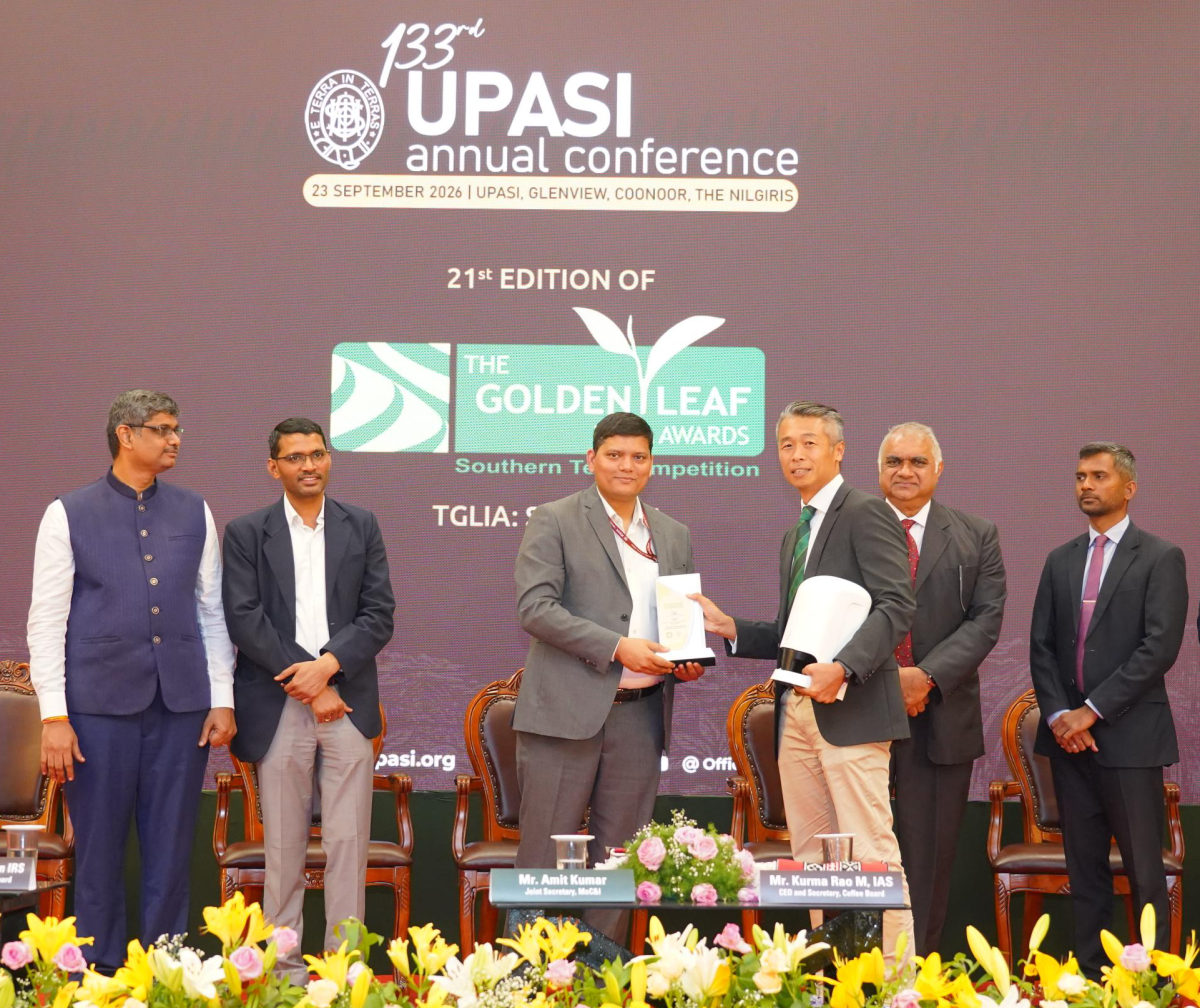
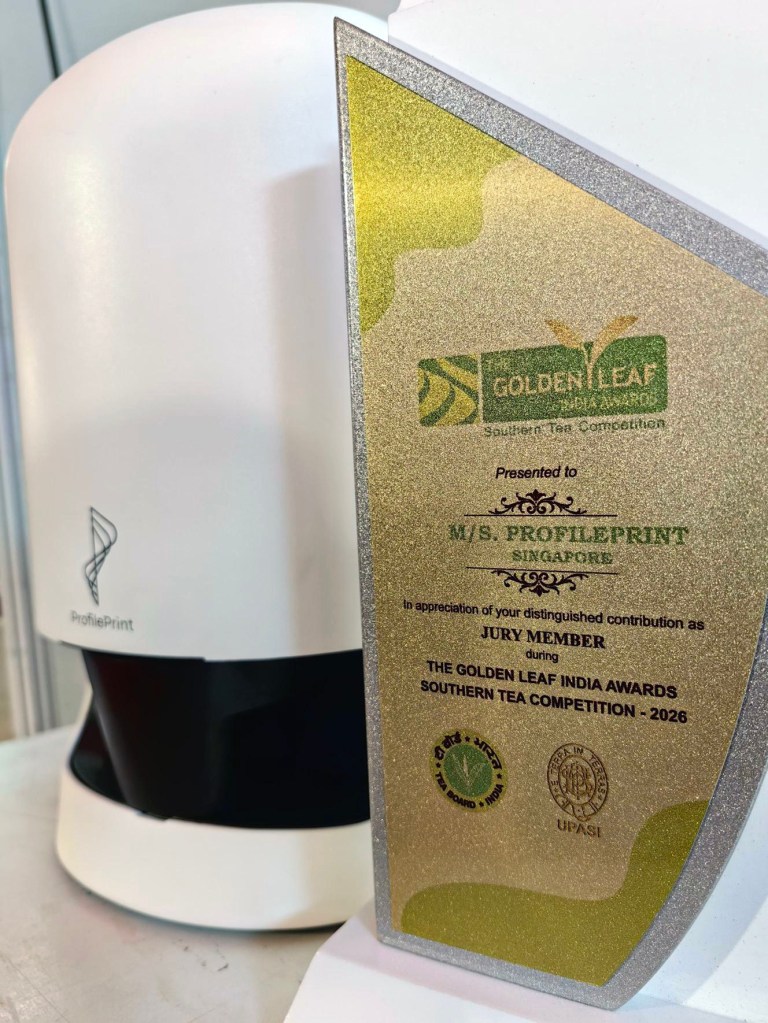
The United Planters’ Association of Southern India (UPASI) and Singapore-based AI company ProfilePrint announced the use of artificial intelligence alongside human tea experts in the 21st edition of The Golden Leaf India Awards: Southern Tea Competition (TGLIA: STC). It is the first time AI has been incorporated into the evaluation process: a model trained on UPASI’s teatasting standard first supported the screening of entries, then served as one of the five jury members in the final round in Coonoor, Tamil Nadu, evaluating finalist teas alongside four international tasters using the same grading standards.
“In a first-of-its-kind initiative, AI-driven tea analysis was introduced for the Golden Leaf India Awards 2026. ProfilePrint, Singapore, used its AI-powered quality assessment technology to screen and evaluate the teas reaching the final round, complementing the expertise and sensory assessment of the traditional jury. This marks an important step in combining advanced technology with the knowledge and experience of tea tasters,” said UPASI Secretary General R. Sanjith.
The initiative began earlier this year when scientists at UPASI Tea Research Foundation (TRF) worked with ProfilePrint to train an AI model for black tea tasting using the TGLIA evaluation parameters. The project focused on digitising the knowledge UPASI has built through decades of tea research and grading. It was led by Dr. Poobathiraj, Tea Technologist at UPASI TRF, who oversaw the calibration and validation.
The model assesses teas across key grading parameters including dry leaf appearance, infused leaf appearance, colour, strength, taste and briskness. Blind-sample validation by external tasters showed a mean absolute error of 0.26 – 0.37 points on the 10-point grading scale.
“The objective of this exercise was to develop an AI model for TGLIA competition, which would also test whether ProfilePrint’s Beluga analyser can learn and reproduce the way experienced tea professionals evaluate quality teas. The blind-sample testing gave us the opportunity to validate the model, and the results gave us confidence that such technologies can provide a consistent reference at par with human experts on sensory evaluations,” said Dr. Poobathiraj.
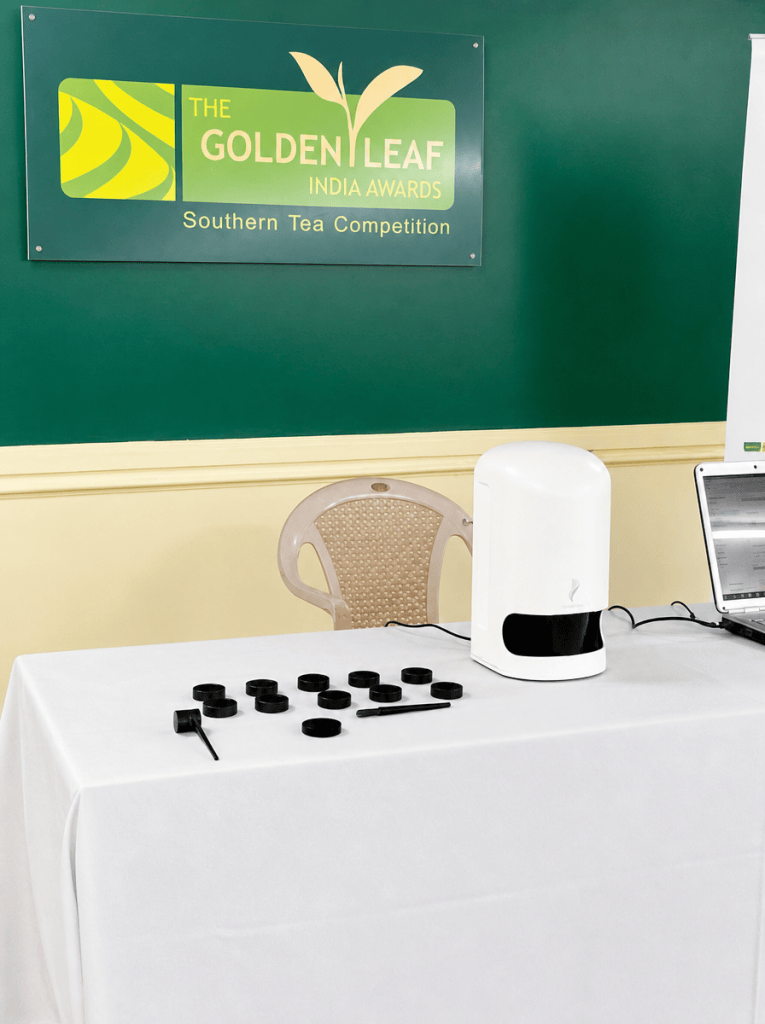
In the early stages, the trained model worked alongside experienced tasters to screen entries and identify the most promising teas across South Indian growing regions and categories. In the final judging session in Coonoor, ProfilePrint’s Beluga analyser was placed beside the tasting cups and expert panel, generating a molecular fingerprint of each tea within seconds and scoring it against the standards used throughout the competition.
This exercise represents a new approach to tea evaluation. Instead of treating AI purely as a laboratory tool, TGLIA placed it directly at the receiving end, allowing machine-generated assessments to sit alongside the judgement of seasoned tasters, a practical demonstration of how tradition and technology can complement one another.
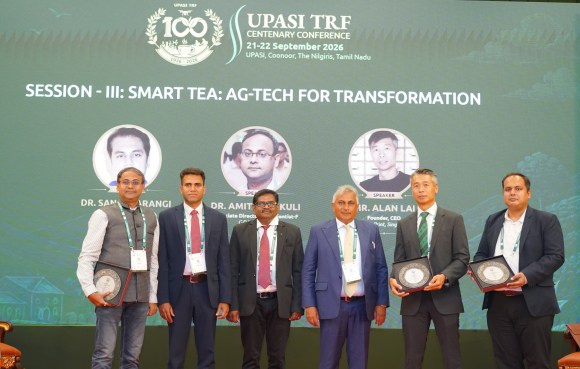
“The tea industry’s expertise has been built over generations. What AI can do is help preserve that expertise, apply it consistently across large numbers of samples, and make quality decisions faster and more accessible,” said Alan Lai, Founder and CEO of ProfilePrint. “We believe the future of quality assessment lies in combining human judgement with AI, not choosing one over the other.”
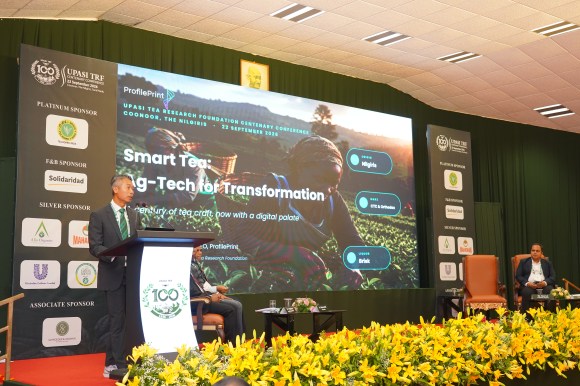
ProfilePrint’s technology captures the molecular fingerprint of a sample and predicts quality attributes against previously trained grading standards, enabling rapid evaluation closer to the point of production, reducing physical sample movement and shortening evaluation cycles.
Building on the project, ProfilePrint and UPASI are exploring opportunities to further develop digital tea standards to help producers, auctioneers, manufacturers, buyers and researchers benefit from faster, more consistent and more scalable quality assessment, while ensuring the industry’s accumulated expertise is preserved for future generations.
About ProfilePrint
ProfilePrint is a Singapore-based food-tech company that leverages patented AI fingerprinting technology to help global agri-food businesses improve the way they buy, manufacture, and sell products. By capturing the molecular signature of samples, ProfilePrint delivers rapid, data-driven insights that enable stakeholders across the supply chain to make faster and more confident quality decisions. Serving over 80 locations worldwide, the company is backed by leading global venture capital firms and major industry players. For more information, visit https://profileprint.ai/.
About UPASI
The United Planters’ Association of Southern India (UPASI) is one of India’s leading plantation industry associations, representing stakeholders across the tea, coffee, rubber, cardamom and pepper plantations. Through its Tea Research Foundation, UPASI supports scientific research, quality improvement, sustainability initiatives and technological advancement across the region’s tea industry.

